Friday’s Faces From the Past: Mystery Relatives?

When I was given a box of old pictures, news clippings and obituaries that belonged to my late maternal grandmother, with help from relatives we were able to identify most people in all the pictures.

Everything that was in the box involved family members, the majority from her parents’ families.  So the surnames involved in other items in the box be Pisani, Bull, Vicari, Henry, Epple, and Blatchley
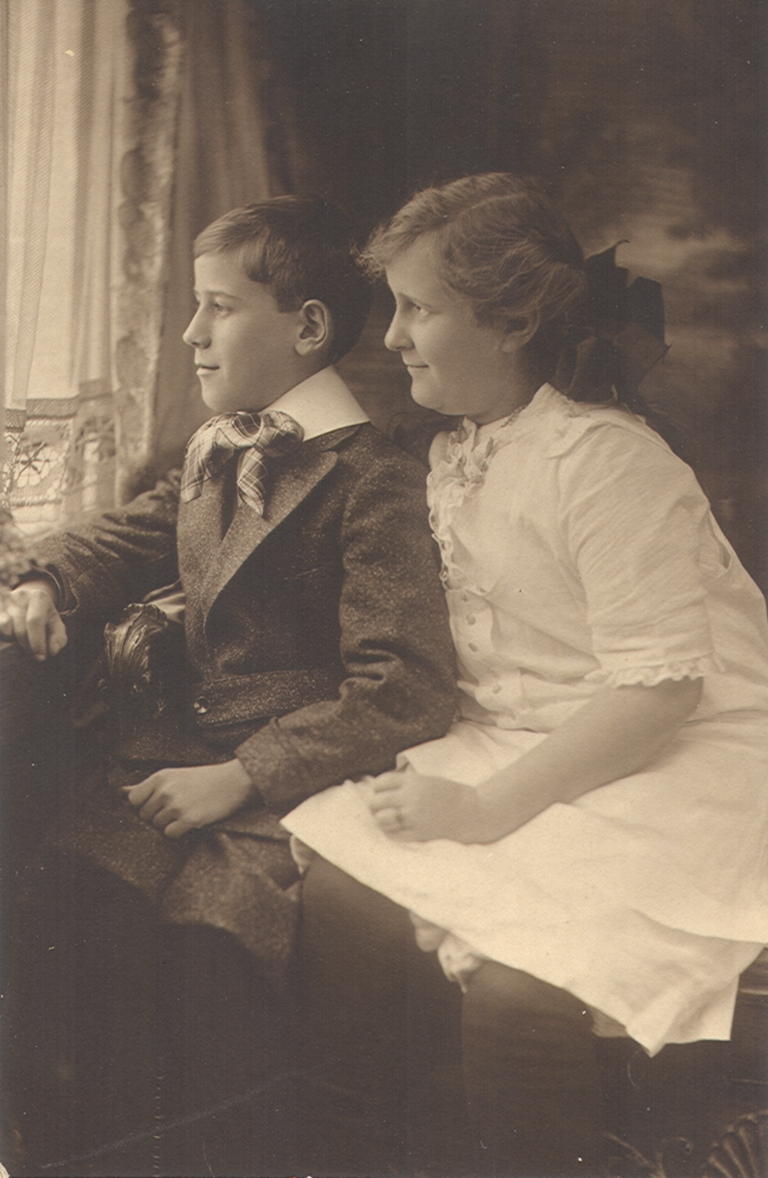
The picture below is a complete mystery.  There is nothing written on the back.  I have sent this picture out to extended family members and no one has had any idea who these two children are.

Mystery Children

Hopefully one day I will solve this mystery.

Those Places Thursday: Great Seats to the Game?

In researching my Epple family, I have learned through the Baltimore City Directories that my 3rd great-grandmother lived at 136 Little (or South) Green Street in Baltimore City, Maryland for from about the late 1860s until her death in 1883.  I knew from a Maryland Real Property search that the house (and street) do not exist anymore. 
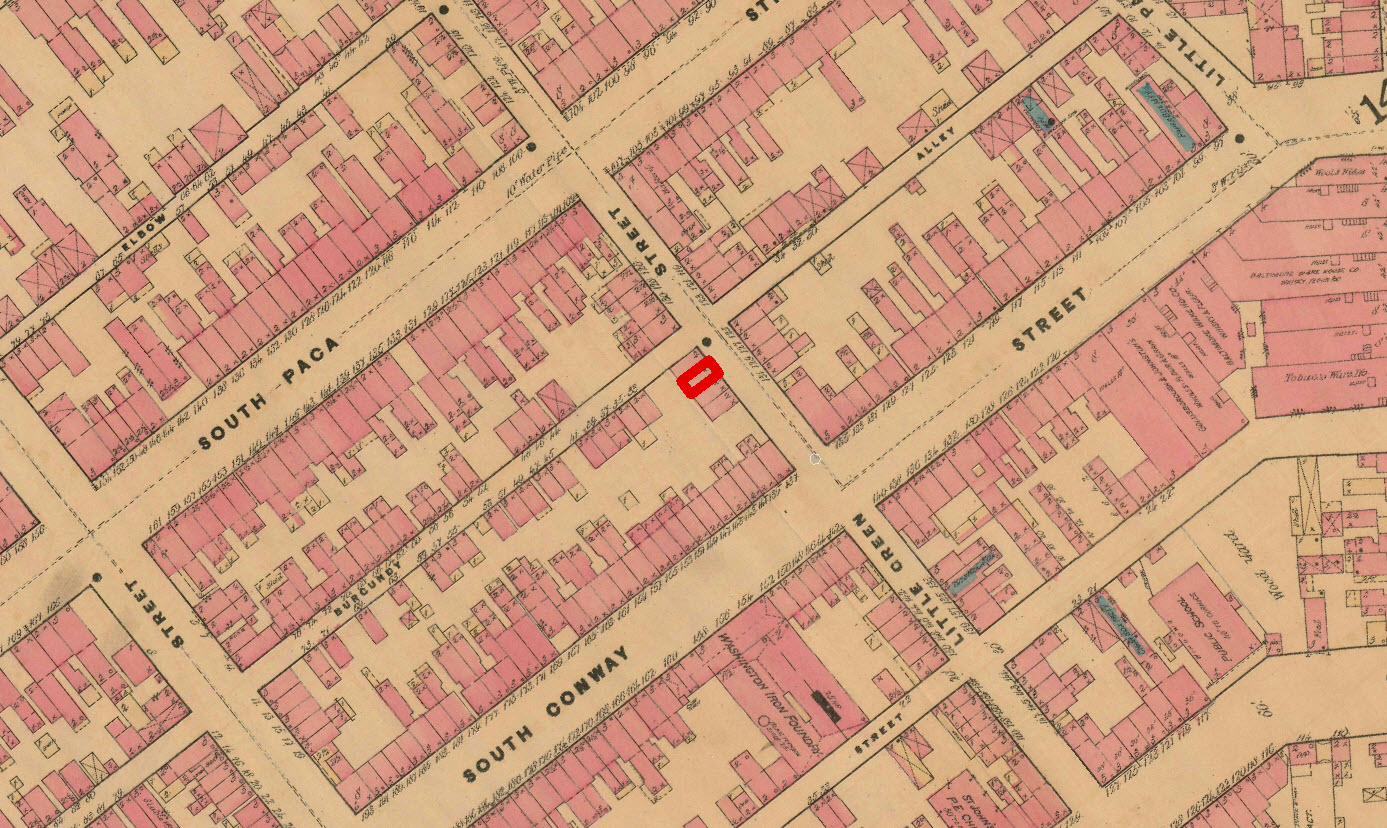
A closer look allowed me to find the 1879/1880 Sanborn map of the area on the Maryland State Archives website.

136 Little Green Street (Red Box) from Papenfuse: Atlases and Maps of Baltimore City and County, 1876-1915 & Block Maps as of April, 2005.  Image: bc_ba_atlases_1876_1915-0638

From my knowledge of Baltimore City I knew that the present day area would be around Camden Yards.
But I wanted to know exactly where.

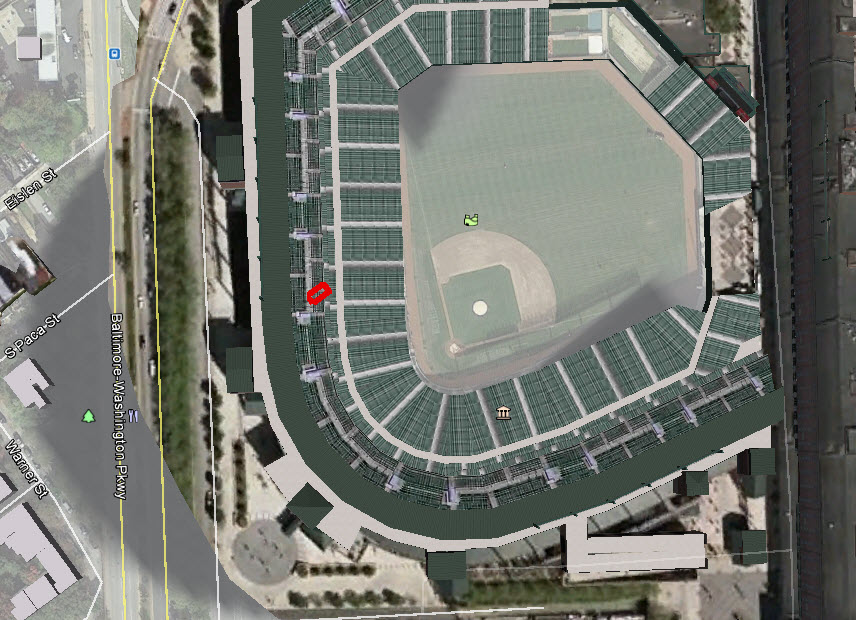
I was able to overlay that map onto Google Earth and low and behold the house was on the current 3rd base side of Oriole Park.

136 Little Green Street (Red Box) on Google Earth with Sanborn Map overlayed.
136 Little Green Street (Red Box) on Google Earth.

Being a huge baseball fan, I thought this was pretty cool!

Epple Go-Over – Part One and a Half

In Part One of my Epple Go-Over I looked at the information I had in my database regarding Rose Epple and her family.  In doing so, I realized that much of the information I had was either unsourced or improperly sourced.  So I spent some time going back and re-sourcing the census information I had and re-examining that info to make sure I didn’t miss anything.

In addition, I pulled out what I had for Rose’s siblings.  Since I am dealing with an immigrant family, anything I can find on the siblings may help link the family back to Germany.
As I pulled out various documents I have collected through the years, both electronic and paper, I realized that I already have a lot of clues that I missed the first time around.

So…that is why I had to have a Part One and a Half.
I have been busy organizing and pulling all the clues out of those documents so I can come up with a clear set of goals for my Epple research.
Stay tuned…

Tuesday’s Tip – Read Source Introductions

I have been looking for one of my ancestors for years in the 1800 Census.  He lived in Baltimore County, Maryland.  It seemed as though the entire county was missing from every source I looked at.

Well, I finally discovered why.

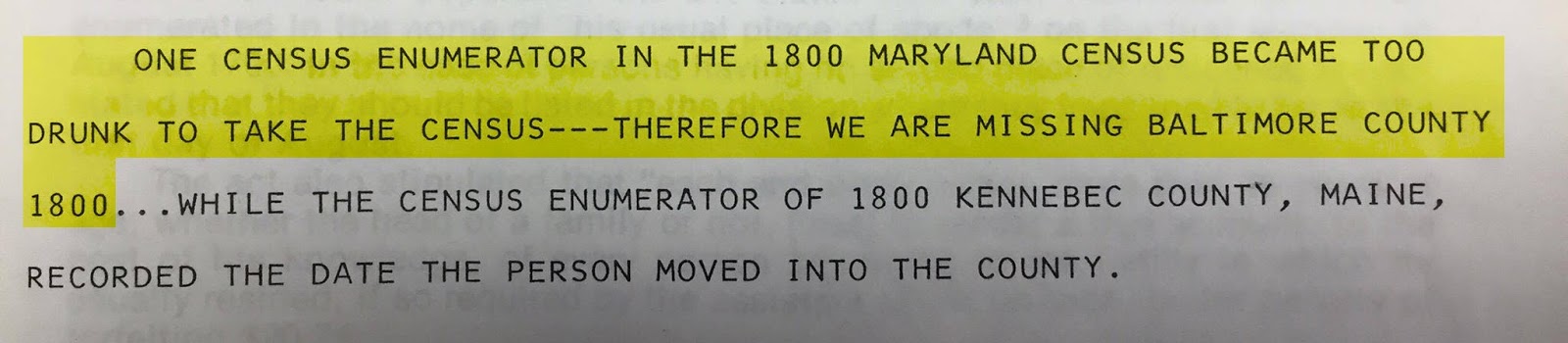
During a trip to my local public library I pulled the book “Maryland 1800 Census Index” from the shelf.  I decided to read the introductory pages…and there it was:

Jackson, Ronald Vern., and Gary Ronald Teeples. Maryland 1800 Census Index. Bountiful, UT: Accelerated Indexing Systems, 1973. Print.

So, read the introductions of sources to find out what is and what isn’t there.  I have known this tip but obviously haven’t followed it.  Maybe if I write it down I will now practice what I preach.

My Ability To Transcribe Deeds Just Got A Lot Faster

I hate to type.  I love land records.  These two things do not go together.

I have found so much great information in land records and I am lucky that many of the records I need are in Maryland.  In Maryland, all verified land instrument records are on-line (and free) through MDLANDREC.  All that is needed to access the records is a username and password, offered with a free registration.

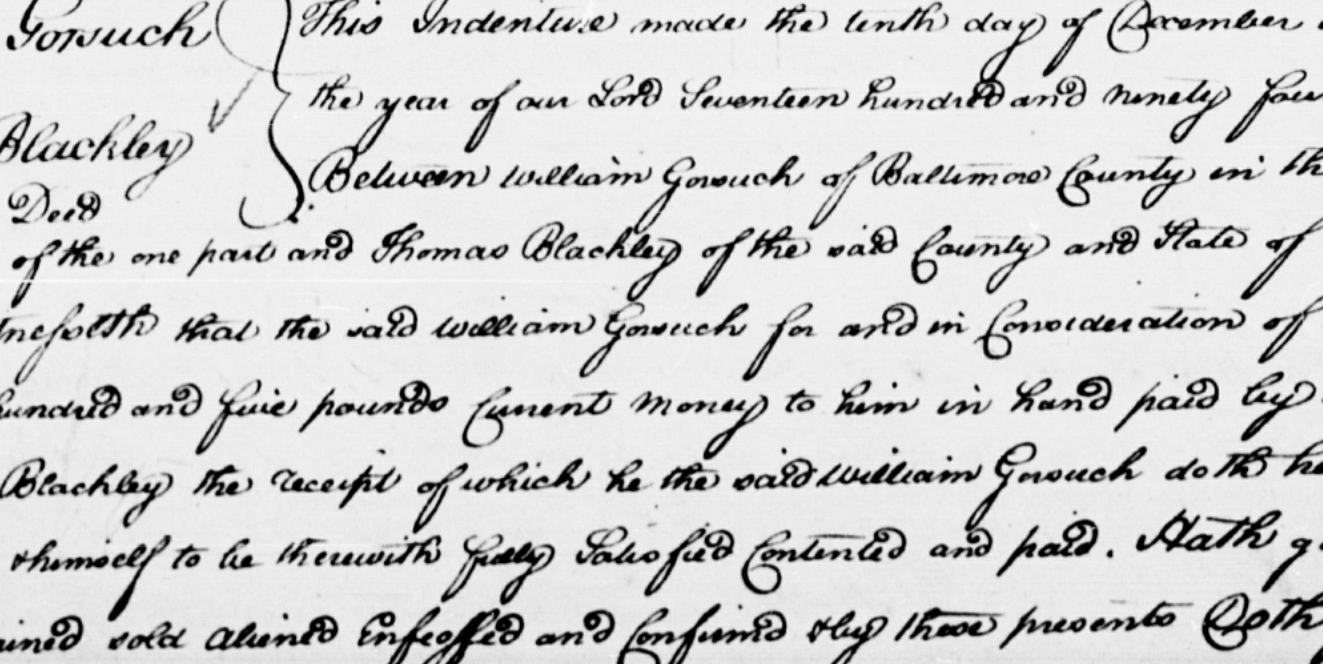
The problem with getting all these great records is that the older records are hand written.  In general the copies are good, but they are tedious to read and even more tedious to transcribe, especially when you hate to type.

SOURCE – BALTIMORE COUNTY COURT (Land Records) WG RR, p. 0172, MSA_CE66-92

So since I had some gift cards burning a hole in my pocket, and a bunch of records to transcribe, I decided to spring for Dragon NaturallySpeaking.  I had heard some good things about the software and several administrative people in my office use it.

After my purchase I installed it and have been using it for about a half an hour.  So far I love it! In fact, I’m not typing this blog, I’m having Dragon do it for me.

I was hesitant on buying a voice recognition program because I have problems with phone systems that can supposedly use verbal cues in their menus.  But to this point I haven’t had any issues.  During set up it had me read a few paragraphs of text so the software could learn my voice.  Also, I have the TV on in the background and Dragon doesn’t seem to have an issue with picking up that noise.

I still have a lot to learn about the software, but to be able to go from installation to using it successfully in ten minutes is awesome.  I’m sure the cost of the software will be prohibitive for some, but for me the amount of time it’s going to save his worth that cost.  I purchased the Premium version which is supposed to work with spreadsheets, so I may not even need to worry about using Google Forms any longer.

Oh, and not only does this software type better than I do but it spells better than I do too!

Using Google Forms to Collect Information from Newspapers

I have been doing a lot of newspaper research recently.  I like to track what I find in a spreadsheet, it allows me to quickly sort my information and color-code cells for analyzing the data.  The problem is I hate to fill out spreadsheets.  I just don’t like the layout when typing in all the stuff I need to put in the spreadsheet.
I use a lot of spreadsheets at work but I rarely create a spreadsheet from scratch.  Usually my spreadsheets are created from some other application that “exports” to the spreadsheet format.  I guess since that is what I am used to, that is what I like.
Also at work I recently discovered Google Forms.  I had to survey some of my co-workers and Google Forms was suggested as a way to create a quick, free survey.  Once I create the survey in Google Forms I can send it to my co-workers and once they fill out and submit the form their responses are collected within a spreadsheet.
As I was learning more about Google Forms I thought, “this may be a tool I can use for genealogy”.

I started doing a little googling.  I was sure I wasn’t the first person to come up with using Forms for genealogy.  I stumbled upon a webinar that Thomas MacEntee did way back in 2011 for the Legacy Family Tree webinar series (Google Forms for Genealogists).  I haven’t heard him really mention Google Forms recently, so maybe he isn’t using them as much as he was then.  Some of the “quirks” he mentioned back then have been addressed in updates to the Forms app, some haven’t.  But I think for my use it will be fine.

So my first step is to figure out what fields I want in my form:
1. Name of paper
2. Date of item
3. Page
4. Column
5. Type of article (Birth, Marriage, Death, Court, Land, News)
6. Transcription of article
7. Link to Image of paper

Based on the type of news item I will then have different fields I want to collect.
For example, if it is a birth notice I want to collect:
– Name of baby
– Name of father
– Name of mother
– Date of birth
– Place of birth

If it is a marriage item I want to collect:
– Name of groom
– Name of bride
– Date of marriage
– Place of marriage
– Name of officiant
Once I figure out what fields I need on the form I will create the form.  Since I will be the only one using it (for now) the form doesn’t need to be fancy.  But it can be customized and themes assigned to the form if you want.

Then when the form is designed I can start using it to collect my newspaper information.

I’ll be experimenting a bit with my form and next time I will have more detailed instructions on the process of creating the form and using it.
If this goes well I am thinking of using a form as a replacement for my vital records spreadsheet as well.
Stay tuned…

Asking For Help The Right Way

In general, genealogists are very helpful people.  Most genealogists love putting on their detective hat and helping others solve a mystery.  
I belong to several genealogy groups on facebook.  There are groups for technology, DNA, photo restoration, blogging, specific locations, and ethnicities.  Most of these groups have some of the most notable members of the genealogy community as members.  I have not only gotten help from these groups but offered help as well.

I continually see posts on these groups that are, for lack of a better phrase, set up for failure.
Let me first say that I do not claim to be an expert in the subject of social media requests.  But because of the amount of time I spend on these groups, I see a lot requests that get wonderful responses and others that are a train wreck.

I also see mentions from people that are afraid to post in groups because they are intimidated.  Hopefully, these tips will lessen that feeling and help you to post a request that will get more positive or helpful responses.

Be specific.

  • Include as many details as you can without writing a novel.  Requests like “I am looking for John Smith from Maryland.  Can you help?” require too many questions from the people who are trying to help.  I read a post like this and usually scroll right by it because there is too much missing. Even if you only have a date range or a location guess, include it.  Was John married?  If he was, did he have any children?  What have you already found about John and his family?  Any details you include can help those who are volunteering their time.

Punctuation and capitalization counts. 

  • I saw a post the other day that was about 20 lines long with no capitalization or punctuation.  AT ALL.  I tried to wade through the question but after 3 minutes I gave up.  I understand that often the people posting requests are not native English speakers, but Google Translate does a pretty good job at translating the punctuation.

    “Which is best” posts.
    I think it is these posts frustrate me the most, not because they are bad questions, but because you are asking for an opinion, and everyone has an opinion!  The four “which is best” posts I see most often are:

    • Which genealogy software is the best?  You will get LOTS of responses to this post, but unless you base your final decision by counting “votes” for each program mentioned, not a good answer.  Most genealogy programs have either a free version or a free trial.  You may have to spend a few weeks playing around with a few different versions in order to make your final decision.  But don’t you want to use a program that fits the way you research, not a program that someone else said is best?
    • What newspaper subscription site is best?  This answer isn’t an opinion, it is determined by your research location and time period.  For researching my York County, PA ancestors I have found the papers available on newspapers.com to be great!  However, it isn’t great at all for researching my Baltimore, MD ancestors.  Visit the subscription sites and see what papers (don’t forget to look at the date ranges) are available.  Also, you may want to pop for a month subscription (be sure to check for the renewal policy first) to see if you find the service worth the cost of a full yearly subscription.  Lastly, including a location and date range may get a response mentioning a free resource, such as a library or other repository.
    • What DNA company is best?  This one is tough because again…it depends on several things.  What are you hoping to find out with DNA?  Also, who are you testing, yourself, another family member?  This will determine which test you should take.  Once you decide on a specific company and test, the success you have in finding matches is basically out of your control.  It is all going to depend on who else out there is getting tested.  I see posts where people say things like, “don’t test with [Company A] because I did and I only have 4 matches”.  Unfortunately, the most likely reason you only have 4 matches is because people who are genetically related to you haven’t tested.  I have one branch of my family with hundreds of matches.  I have another branch that I only have a couple matches.  Hopefully that will change as more people test.  Also, taking a DNA test isn’t going to fill in your entire family tree.  But hopefully it helps you make some “cousin connections” to help fill in some blanks.
    • I can only afford to pay for one subscription site, which one should I pick?  Again, there are too many determining factors to adequately answer this question.  What is your research concentration area and time period?  What type of information are you looking for?  Even with that information the answers will be largely subjective based on the success other researchers have had with their own research. It is a common question, just hard to give one solid answer.  Also, many public libraries, genealogy societies and family history centers have subscriptions that you can access for free at their location.  In my area, the public library has a world subscription to ancestry.com.  I have to go to the library but I can access it through my own laptop as long as I am connected to their wi-fi.  The only drawback is that I have to comb my hair and put on pants.

    Be respectful. 
    The more respectful you are to other members of the group AND to the administrators, the more pleasant your experience will be.  Everyone, from the admins to the other members are donating their time on these groups.  They don’t “owe” you anything, but will most often jump in to help if you are respectful.

    • Be patient.  Many groups are “Closed groups”.  This means you have to request to join and an admin has to approve you.  These groups have administrators that donate their time to moderate the group.  It may take a day or two for the admin to get to your request.  The more popular groups may get lots of requests a day from people.  They will get around to you.  Also, different groups have different criteria for their members, but nothing outlandish.  They don’t want trolls.  They want people who have a genuine interest in the topic of the group.  In the genealogy groups, they will generally check your profile to see if you have an interest in genealogy.  Depending on your security settings they may not be able to see what other groups you belong to or what your interests are.  In this case, it may take longer to get approved.  But don’t sweat it.  Sometimes there will be a pinned post from the administrator on the group page.  You can send them a message if you are worried that you may not get approved, for example, if this is the first group you are joining.
    • Before you join, read the rules.  Most of the groups on Facebook have rules.  This is to make sure the page just doesn’t end up being a big advertisement page. Make it easier on the admins and follow the rules.
    • “Someone deleted my post.”  I see this many times on the RAOGK group.  99 times out of 100 the post was not deleted, there have just been so many posts that yours may fall way down on the page.  Search the group to try and find your post before accusing the admin of deleting it. Every group has a search field you can use.  It is located on the right side, at the bottom of the group cover picture.
    Search this group field
    • Don’t hijack someone else’s thread.  Do not ask your own unrelated questions on someone else’s post.  This can lead the thread off of the original topic which is not fair to the original poster.  Also, your question will probably not get the attention it deserves because it is buried in someone else’s post.
    • “Close” your thread once you get an answer.  If you post a question or request and get a resolution, please go to your original post and edit it to by adding “SOLVED” before or after the question.  This will prevent people from trying to help with something that has already been answered.  Don’t delete your post though.  Others may come along with a similar question and be able to read through the thread of your post for the answer.

    Be appreciative.
    Remember, people have volunteered their time to help you out.  You don’t have to buy them a new car, but a thank-you can go a long way.  Maybe when you close your thread instead of just putting SOLVED, you can write “SOLVED-Thank you to all that helped!”   If someone has gone above and beyond, send them a message or post a thank you to them in the thread. 

    Don’t rely on others to do all your research.
    I see people that will post 10 requests for research help in a row.  Sometimes it is obvious that the original poster hasn’t tried to do any research on their own.  These groups are created to provide help, not do all of your work.  I will tend to bypass posts from people who post multiple requests and never supply any “known” information or information on where or what they have already researched.

    “I sent so and so a message but they never responded.”  On facebook, if you send a message from someone who is not your FB friend, the message goes into a folder called “Other”.  Messages that go into the Other folder do not show up in your notifications.  Many users know not of this “other” folder.  So they may not be ignoring you, they just don’t know that message is there.  The few times this has happened to me I have posted in the group something like “Hey so-and-so, I sent you a message.  If you have not seen it, please check your “Other” folder.”  Also, if you never checked this folder before you may have some invitations from some very nice young ladies…LOL

    The “Other” folder

    Some questions may not get a satisfactory answer.   Sometimes I see a post about how a group “isn’t helpful at all”.  Then I will go to the group, search for the post and read the replies.  Even though the facebook groups have smart, resourceful and experienced researchers, it is possible that you just won’t get a clear, definitive answer.  This may be no fault of your own or the group, the answer just isn’t there.  Put that question away for awhile and try again in the future.  Again, be thankful for any clues you may have gotten but don’t automatically think that the group isn’t helpful.

    Hopefully these tips are helpful to those who may be a little intimidated when it comes to using facebook groups or for those who scratch their heads because they aren’t getting responses.

    Going Paperless??

    Anyone doing genealogy research knows there is paper…stacks and stacks of paper.  There are books, there are copies of newspaper articles, death certificates, marriage records, pictures, census records, military records, letters, land records, funeral cards, funeral books, spiral notebooks and other notepads full of miscellaneous notes.

    I usually handle all the paper by scanning the paper, saving the scanned image on my hard drive and on Dropbox and then filing the originals in my file cabinets.
    When I receive a paper record, if I don’t have time to scan it immediately I place it in a bin in my office and wait for a nice rainy day to scan everything in my bin.  Since electronic delivery is becoming more popular, my bin does not fill up nearly as quickly as say 10 years ago.
    Scanning allows me the flexibility of attaching the records to my genealogy database for that particular event.  Additionally, since I have a copy in the cloud, I can easily email or share files directly with family members.

    I am very comfortable with this process for most of my paper “stuff”.  MOST.  I do not follow the above process for my notes, and boy do I have notes!
    I am a serial note taker.  I think it stems from my school days.  Many of my teachers were “lecturers”.  They talked, we took notes.  There were minimal handouts.  We had textbooks but the majority of the classroom time was spent taking notes.
    So in my adult years I jot down things all the time, for everything from reminders to pick things up at the store to reminders to call people, etc.  For my “personal life” notes I typically use the Notes app on my phone, or I set up a reminder on my phone.  This works fine.
    But what about my research notes. The main problem is that my research notes largely have no organization.  I grab whatever is at hand, scribble a note and throw it in the pile.  I have at least 15 spiral notebooks and probably 30 notepads of various sizes with no more than 10 pages written on each, some pages may have just a single line.  There are also post-its, napkins and scraps of paper, some even just corners of papers torn from something, who knows.
    I will come across something, a name, an address, a reference and think “oh, I have a note about that” but then I can’t find it because there are so many notes to wade through (if I am even at home when it comes up).  So, how do I resolve this?

    Well, since most of my genealogy stuff exists digitally (the exception is large maps and portraits that are hard to scan), why not convert my notes to a digital format??  If my notes are digital then they become portable if they are “in the cloud” without lugging around a big box of notebooks.
    OK, well, since I embrace technology this is a no brainer…digital it is!

    Next, where do I store these digital notes in the cloud?
    I am a heavy user of both Dropbox and Google Drive.  I started using Drive first and like it because it integrates so well with my other Google apps.  Then I started using Dropbox, liked it as well, and it is easy to earn extra storage space.  I earned a bunch of free space and then moved much of my genealogy stuff to Dropbox.  I still rely on Drive for my personal on-line storage.
    So, either of these services would be a natural choice right?  Hmmm, maybe not.  Drive and Dropbox are great at storing files, any kind of file.  If I scan my existing notes as PDFs I can store those PDFs.  But besides naming the file it really isn’t an “intelligent” note and not searchable.

    Then I thought about Evernote. It is made specifically for notes, all kinds of notes.
    I have had an Evernote account for several years.  I have never really used it because I wasn’t committed to using it.  In fact I haven’t even logged into my Evernote account in probably 2 years.  However, I’ve read several articles recently about using Evernote for genealogy and it has made me want to dive head first into the Evernote world.  It seems much more evolved than when I first got an account.
    Evernote allows users to create notes and notebooks. There is also the ability to add tags and text is OCR’ed, making notes searchable.  It allows the user to “clip” items from webpage, so all my notes from some page I saw on the internet can not be captured more accurately (because we all know websites change).

    My next week or so is going to be spent reading and watching tutorials on Evernote to figure out how I should import all my existing notes.  Then to wade through all those paper notes and get them into Evernote.

    I guess I need to hope for a lot of rainy/snowy days in the future!

    Filling In The Blanks: Part Six

    This post continues my Edna Henry and family project.  I have been working on this for almost a week at an average of about 1-2 hours a day or researching.

    Since I have William and Florence’s death dates from the land records and found both of their death notices in the Baltimore Sun, I want to see if I can locate their death certificate information in the Maryland death indices.
    I will not be able to obtain the death certificates anytime soon.  They are $25.00/certificate when ordered on-line (they are certified).  So I like to wait until I have quite a few to get and then I go in person to the Archives in Annapolis, Maryland.
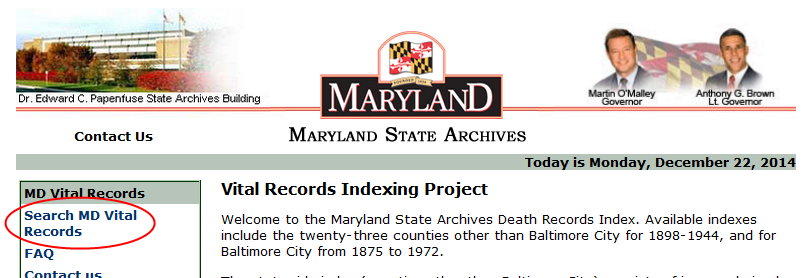
    The indexes are available on-line at the Vital Records Indexing Project.
    The index is free to search and does not require any registration.  However, if you choose to generate a death certificate order you will need to create a free account.
    On the main page, click Search MD Vital Records.

    http://mdvitalrec.net/cfm/index.cfm

    Clicking the Search link yields the search page.
    The Baltimore City indexes are separate from the County indexes.  For the county indexes, all counties are included within each available date range.
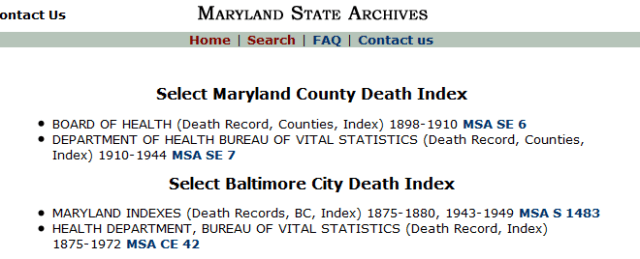
    Search page

    I will search Baltimore City first as 3030 Westfield Avenue is in Baltimore City and the closest hospitals to that location would have been in Baltimore City.
    So I will click on the Baltimore City Indexes for 1875-1972.
    The City indexes for 1875-1880 and 1943-1949 are different as the records are not scanned.  You have the ability to type in names and years.  For the rest of the indexes there are scanned images of either cards (for the counties), or index pages (for the city).

    I will select 1937 to search for William.
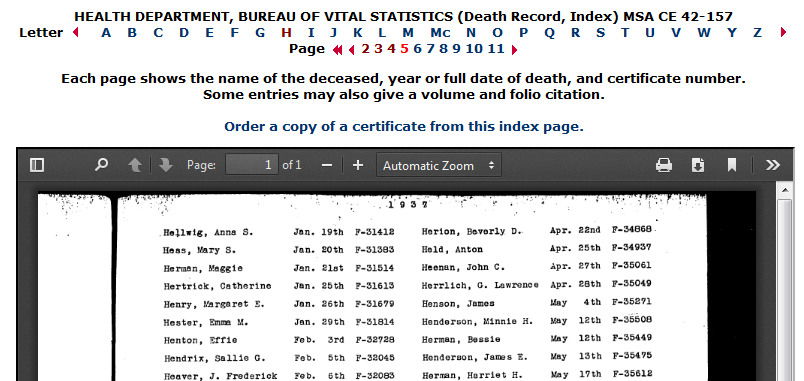
    The indexes in this time period are typed pages arranged by first letter of last name, then organized by the first vowel in the name and finally listed in order by month and day of death.  Earlier indexes are hand-written and sometimes arranged by first letter of last name and then first letter of first name.  Also, the earlier indexes that contain multiple years within a single index are a bit jumbled.  Later indexes are organized by soundex.

    I go to page 5 which covers the “H” “e” for May (William died on 5 MAY 1937).
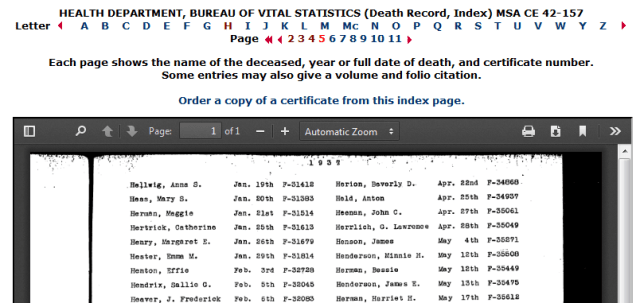
    1937 Baltimore City death index

    William R. is not listed in that time period.  I do notice however that scanning further down the page is  a “Henry, William R.” on Jul. 11th.  Hmmmm.
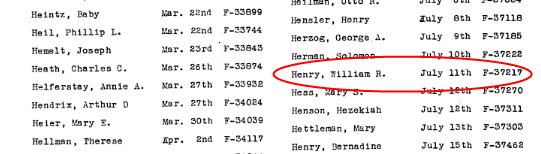
    1937 Baltimore City death index

    Could his death certificate somehow have been misfiled?  I do a quick search of the Baltimore Sun for July 12-16, 1937 and do in fact find a death notice for William R. Henry that died on July 11th.  There is mention of his parents (names that are not familiar) and he to be buried in Ohio.  This isn’t my William.
    So, perhaps he did not die in Baltimore City.  Next I search the county indexes.
    I click on the index for “1934-1944 Han-Hor” and page through the index and realize that the index is mislabeled.  It only covers “Han-Har”, the last card in the index is for George W. Harvey.
    I go back to the main search page and check the indexes for “1934-1944 Gam-Ham” and “1934-1944 Hos-Jones, J.” as maybe those have been mislabeled as well.  I find nothing for “He”.
    Well, this is disappointing!

    Now I will search for Florence.  I go back to the city index for 1939.

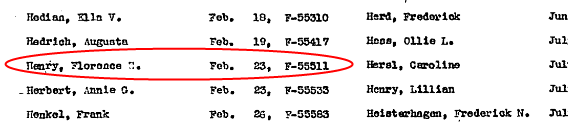
    1939 Baltimore City death index

    Yay!  Finally! Progress!
    Although I plan on pulling this death certificate myself on my next visit to the Maryland Archives, I still like to generate an order form.  I like to print those out and place them in a folder that I labeled “Archives Search” so I have all the information I need when I go.
    At the top of the search page I will click on the link to “Order a copy of a certificate from this index page”
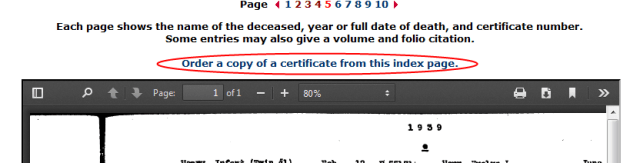
    Ordering a death certificate

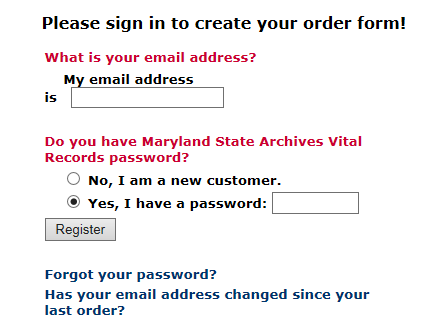
    At this point I am prompted to log in or create a new account.
    Since I have an account I will just log in.
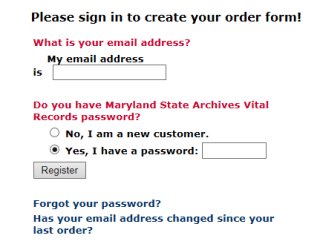
    Log in screen

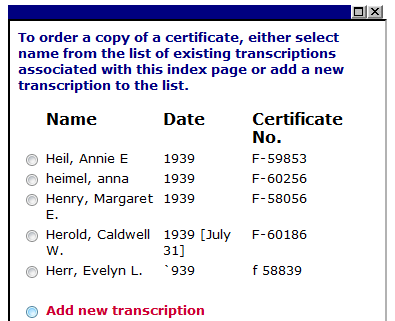
    Others have ordered certificates from this page based on the window that pops up.
    I like when a certificate I am interested in shows up here because it means at least one other person out there somewhere is interested in this person as well.
    Florence isn’t on this list so I have to “Add a new transcription”
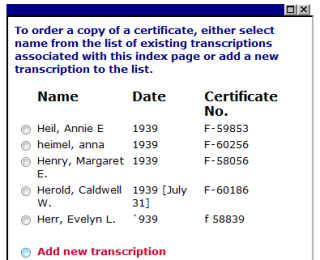
    Existing transcriptions

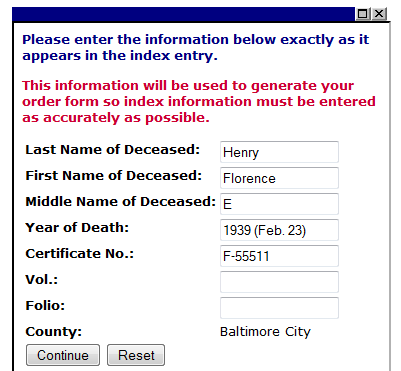
    I fill out the form.
    Notice that for the date it only asks for the Year of Death.  I like to put the date in parentheses so it prints out on the form.  For this date range there are no Volumes and Folios listed in the index so I just leave that blank.

    Transcription for Florence E. Henry

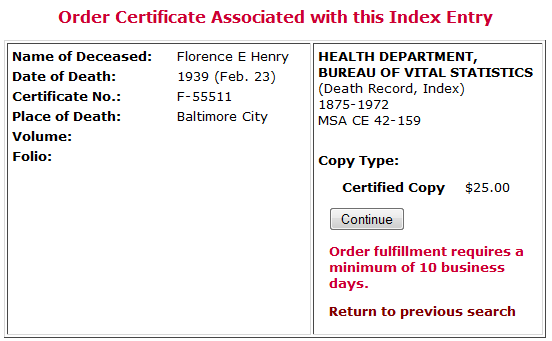
    When I click Continue the transcription and pricing information is generated.

    After clicking continue, the screen shows my Shipping and Billing information since I already have an account. No screen shots here!!  HA!
    Next it generates the order form which I can print out.
    The page can be sent directly to the printer.  If your computer has a PDF print driver installed you could also save it as a PDF file.
    Since it is in HTML format it can be saved, but as a webpage.

    At this point I have all the information I can get from the death index, but I still do not have any information on William’s death certificate.  My guess is that he died in a Maryland county but it is entirely possible he didn’t even die in Maryland.

    Since his death notice in the Baltimore Sun said he was to be buried at Moreland Memorial Park I will check findagrave.com and billiongraves.com to see if there is an entry for him.
    Findagrave.com only has one Henry entry (not him) for Moreland Memorial Park and there are none for billiongraves.com.

    I decide to try to give the cemetery a call to see if they can provide any information over the phone.  Some cemeteries will, some won’t.  Since I live near the Baltimore area I can certainly visit the cemetery in person.  However, it is a large municipal cemetery so walking it to find them will probably not be productive.
    Before I call I check their website for information (some have maps on the site, Moreland Memorial Park does not) make a list of my questions:

    1. In what plots in the cemetery are they buried?
    2. Do they have maps of the cemetery in the office?
    3. Does she know where William died?
    4. Does she know what funeral home handled the arrangements?
    5. What were their birth dates?
    6. Is there anyone else buried in their plot?
    7. Can I get a hard copy of the information? 

    I call and the lady that answers is very nice and offers to look him up. So I start down my list.

    1. They are buried in Section E-14, Plots 1 and 2.  She then says the graves are unmarked.  Of course they are, that is my luck.
    2. Yes, they have maps in the office.  I want a map!
    3. William died in Sykesville, Maryland.  She also mentioned that Florence died “at home”.  Sykesville, could he have been a patient at Springfield State Hospital?
    4. L.J. Ruck handled William’s arrangements.  I will have to check to see if Ruck has any funeral home records available.

    At this point she says that she needs to go because the other lines are ringing.  I am not upset, I will try to visit in person soon.  Most likely, since she gave me some information over the phone, I can get more in person, and hard copies.

    So, if William died in Sykesville (Carroll County) that would explain why I couldn’t locate him in the death index since the county index was missing for part of the alphabet.

    I can pull the certificate pretty easily knowing the county and the date but it would still be nice to see it in the index.
    That is when I remember that the indexes are also located on the Maryland State Archives Guide To Government Records.
    I go to the guide, go to death records and scroll down to The County Death Records 1898-1972.
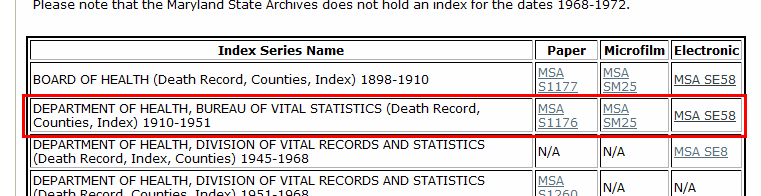
    I find the correct series and find that they have an Electronic version.

    http://guide.mdsa.net/viewer.cfm?page=death

    I click on the MSA SE58 link to bring up the county index lists, scroll to the appropriate date range  and click the Link button.

    http://guide.mdsa.net/series.cfm?action=viewDetailedSeries&ID=SE58&column=%5BID%5D&sort=asc&page=2

    This is a huge file so I give it some time to fully load, it took a couple minutes to load the 10,106 pages in the index.
    I don’t want to scroll through a bunch of pages so I take a guess and jump to page 5000. Hensley, not bad, pretty close.
    Let’s try 4970.  Henry, Walter Eugene.  Getting closer.
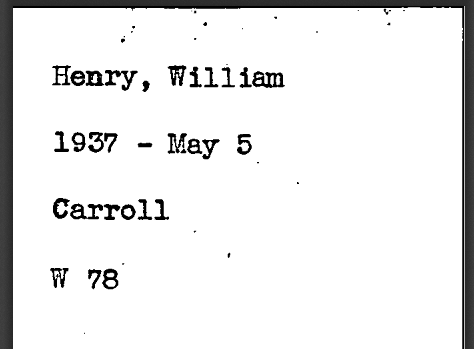
    Page 4972 is the winner.  Found him.

    http://msa.maryland.gov/megafile/msa/stagsere/se1/se58/000100/000116/pdf/se58-000116.pdf   Page 4972

    Now I feel better that I did find him in an index.  This wasn’t necessary, as I said before I could have pulled his certificate without the index but it does verify that this William Henry died on May 5, 1937 in Carroll County at age 78.  My William was born about 1859, that would make him 78 in 1937.

    I print out the index card and place it in my Archives search folder.

    Let’s do a quick check to see where I am with my goals:

    1. When and where exactly was William born?  Don’t know.  Hopefully when I get his death certificate I will get a clue to that information.
    2. When and where did William die?  May 5, 1937 in Carroll County, MD (Sykesville).  More specific info should be on his death certificate.
    3. When and where were William and Florence married?  I haven’t even started this search yet!
    4. What is Florence’s maiden name?  SPARKS.  I need to do some searches and see if I can find her before she got married to William.
    5. What happened to Edna’s husband (since no one remembers him, only her)?   Oh Edna!  You are killing me with this one.  My mother said she was going to visit Aunt Ruth today, maybe she will remember something to give me a hint.
    6. Can I find any new information on William that will lead to new information on his father John Baker Henry, brother Charles Dorsey Henry or grandfather Charles L. Henry?   Not yet.

    I realized in my goals I forgot to add my goals for Florence (where/when she was born and where/when she died.  She died Feb. 23, 1939 in Baltimore City, MD (most likely at 3030 Westfield Avenue).  Her death certificate should hopefully provide that information and birth information as well.

    I have much that I still need to do but I am headed in the right direction.
    This will be my last post on this project.  I will try to post an update as I find more but I think that I showed how to use some of the resources for Maryland research.  That was my big picture goal.  Search strategies will always vary depending on what information you have and what you want to know but hopefully this gave less experienced researchers so pointers.

    My other suggestions:

    -Use a research log.
    When I first started researching I know I searched the same resources for the same person multiple times because I didn’t keep a log.  Many free logs templates are available on the internet.

    -Make sure to source your records.
    You should be able to pinpoint exactly where your information came from, even if it was from a conversation with a relative.  The internet is a great resource but it is ever changing.  Records you find on-line today may be moved, web sites change etc.  Don’t assume you will remember where it came from!

    -Revisit your information every few years..
    More and more records are becoming available.  Just because you can’t find it now doesn’t mean you will never be able to find it.  When I first discovered this family in the early 2000s I could not have found all this from the comfort of my home office.  It was all available, just not so easily.

    -Field trips are good.
    All of this on-line research will be followed up by some field trips.  I will go to the library to search for more newspaper articles.  I will go to the MD State Archives to pull death certificates, birth information for Edna, and marriage information for William and Florence.

    -Don’t forget about genealogical and historical societies.
    Although I didn’t use them here, another great resource for Maryland research is the Maryland Historical Society and the various genealogical societies. It may not be financially possible to join all of them but join at least one and try to be as active as possible.  You research will improve and you never know who you will meet!

    -Check your local library to see what services they provide for genealogical research.
    Public libraries many times offer access to subscription services; Ancestry.com, genealogybank.com, newspapers.com, local newspapers.  Also see what microfilmed records they have.  Different branches may have different resources.  I have a U.S. subscription to ancestry.com but go to the library if I want to search the World records.  I can use my own laptop by connecting to their wi-fi network. 

    Join social media groups.
    Message boards and mailing lists are not as popular as they used to be but groups on Facebook, for example, are on the rise.  You never know who you will connect with.

    Filling In The Blanks: Part Five

    Continuing my Edna Henry and family research. In Part Four I found potential death dates for William and Florence in the land records for 3030 Westfield Avenue.  Now I want to get some other sources for their deaths.
    Today I am going to see if I can find death notices for William and Florence in the Baltimore Sun.
    I have a Baltimore County Public Library card so that allows me to access the archives over the internet.
    The Baltimore Sun is not the only newspaper that would have a death notice but it is the one I can access from home, so it is the first one I check.  On my next trip to either the Baltimore County Public Library (I usually go to the Towson Branch) or the Enoch Pratt Library (I usually go to the Central Library) I will search other papers.  The Baltimore Sun may have just a death notice whereas other smaller, more local papers may have a larger article.
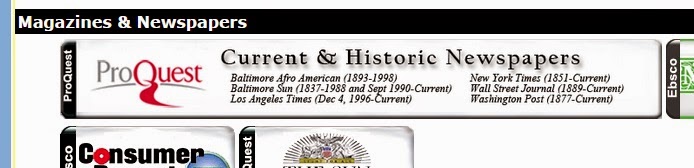
    I go to the page and then scroll down to the Magazines & Newspapers area.

    http://www.bcpl.info/find-info/databases

    I log in on the next screen which leads me to the search page.
    Notice that the database covers several papers.

    Newspaper Options

    In this case I only want to search the Baltimore Sun (1837-1988 and Sept 1990-Current).  If I can’t find anything I will expand the search to all the papers.
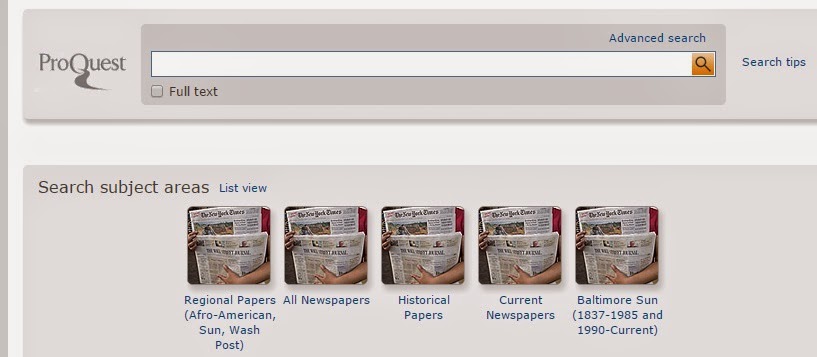
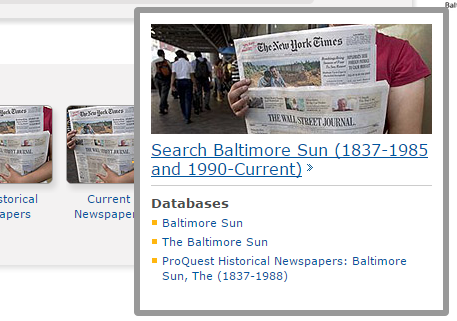
    To limit my search to the one I want I will hover my mouse over the Baltimore Sun (1837-1988 and Sept 1990-Current) and click “Search Baltimore Sun (1837-1988 and Sept 1990-Current)”.

    Limit database search

    This brings up the search for the database I want to use.
    To find William and Florence’s death notices quickly, I want to limit the search further to specific dates ranges.  Let’s start with William.  The land records had a death date for William of “on or about May 5, 1937”.  Assuming he did die on the 5th, his death notice may appear on the 6th or 7th at the earliest and may be run until the funeral, maybe the 8th to the 10th.
    I am going to search May 6th through May 10th and if I don’t come across anything I will expand the search.
    At this point I don’t know where or how William died.  There are many factors that could affect his death notice appearance, if there even was a death notice.  I am using a date range that is typical for death notices, about a week from the death date.
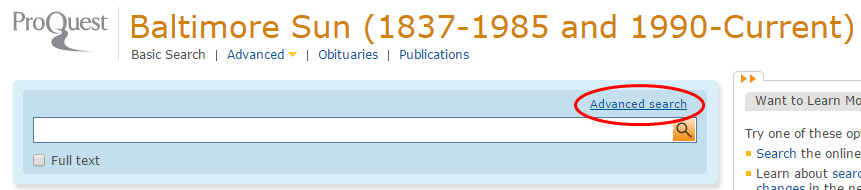
    To limit the date range I will use the Advanced search.

    How to launch Advanced search

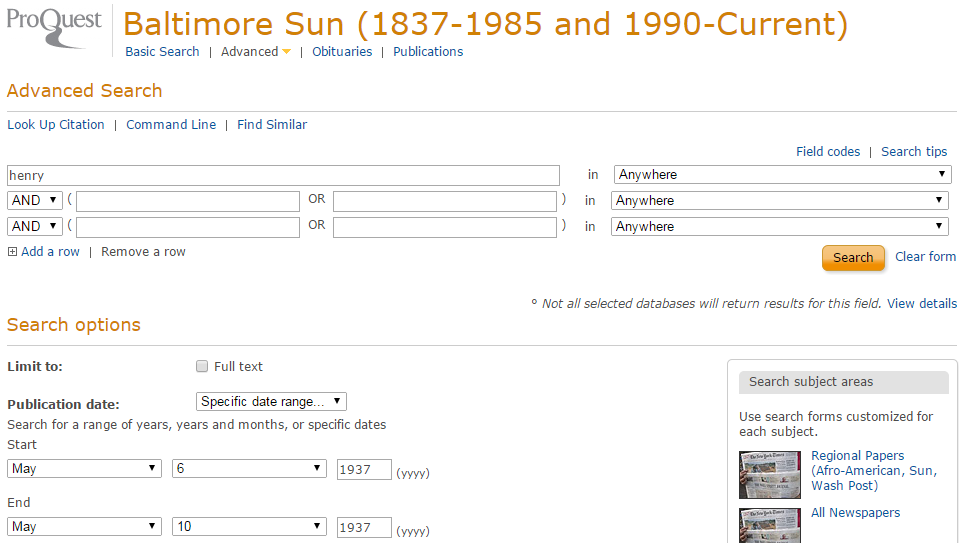
    I fill out my search terms and my date range.  I am just searching by the name “Henry”.
    Many times, because of the format of the death notices, using the last name yields better results than using the full name.  This is just my experience.  Also, you notice there is an option to search Obituaries.  Although I am searching for a death notice, I don’t want to limit to just obits.  You never know, there could be another article about him that would not show up in the limited obit search.

    Advanced search

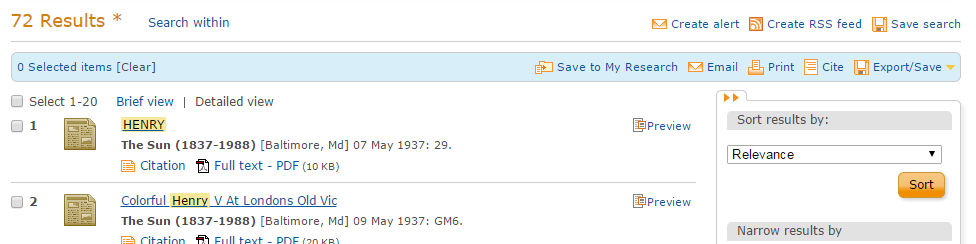
    I get 72 results for the 5 days in my search range.  The first one in the list is promising.
    Notice on the results page you can change the sorting of the results.  The default setting is “Relevance”.  Usually if I am searching a wider date range I will change it to “Publication date (show oldest first)”.

    Search Results

    I click on the first result.  I am hesitant on posing the image due to copyright but the transcription is as follows:
    HENRY. – On May 5, 1937, WILLIAM
     R., beloved husband of Florence E.
     Henry (nee Sparks).
      Funeral from his late residence,
     3030 Westfield avenue, on Saturday
     at 2 P.M.  Interment in Moreland
     Memorial Park.
    SOURCE – The Sun (1837-1988); May 7, 1937; ProQuest Historical Newspapers: Baltimore Sun, The (1837-1988); pg. 29; col. 7

    The database gives me a choice to print or save the information.  I usually like to save it (in PDF format) but I like to save the entire page.
    I like to have the articles in relationship to the entire page.  When I source a newspaper item I like to cite the section (if applicable), page and column and I like to attach the entire page to my source in Legacy.  Obviously this isn’t possible for clippings I receive from relative, etc. unless I can go back and find the whole page.  If I access newspapers on microfilm where I can’t print out the entire page, I always note the column for my source citation.

    I click on a few other items in the results list but besides the same death notice on May 8, I find no other articles about William’s death.

    I next run a similar search for Florence and get 102 results.  I get a hit on a death notice:
    HENRY. – On February 23, 1939, FLOR-
     ENCE E. (nee Sparks), beloved wife
     of the late William R. Henry.
      Funeral from her late residence,
     3030 Westfield avenue, on Saturday
     at 3 P.M.  Interment in Moreland
     Memorial Park.
    SOURCE – The Sun (1837-1988); February 24, 19397; ProQuest Historical Newspapers: Baltimore Sun, The (1837-1988); pg. 21; col. 5

    While I am here I will do a search for Edna as well.
    I don’t want to limit the dates this time so I will do a basic search for the phrase “Edna B. Henry”.

    I get 2 results for real estate transactions for another address, 2901 Bauernwood Avenue.
    I make note of the address and date and make a to-do item to go back to the land records to search this property.

    Now I search the phrase “Edna Henry” and get 27 results.  Many of these mentions are probably not her as they are from other states for years when she was very young and wouldn’t be “working in Virginia” but some of them have a better probability of being her.
    I save each possibility for closer inspection later.

    • Attended a birthday party in Nov 1906 for Gladys Elizabeth Cox, the daughter of Mr. and Mrs. Henry Cox in Govans, MD.
    • Participated in a piano recital and musical in April 1907
    • Graduated from Govanstown public school in June 1909
    • A lawsuit filed against United Railways for $10,000  (this one is a long shot, but worth exploring more)

    I am pretty sure the first 3 are my Edna Henry because of the mention of Govans/Govanstown where William and Florence lived during those years.
    The birthday party and piano recital may seem insignificant but I always make note of the other names mentioned, especially the party.  If Edna attended a birthday party it was probably a friend, maybe even a relative I have not yet discovered.
    A few other interesting items:

    • An article in the Feb. 20, 1955 edition called “I Remember…A Child’s Govans in 1900” written by Mrs. Edna Henry Wasson.  The article mentions her father’s blacksmith shop, although it lists his middle initial as “P”.
    • Letters to the Editor on Apr. 10, 1955 and May 8,  1955 commenting on her article.

    There is the Wasson name.  So maybe she just used her married name when she felt like it?  So weird!
    I also searched “Edna B. Wasson”, “Edna Wasson”, “Benjamin Wasson” and Benjamin H. Wasson” with no results.  Searching “Wasson” yielded 956 results.  I will plow through those later.

    On my next trip to the library I will definitely search the other papers on microfilm for more extensive obituaries but for now what did my search yield?

    • May 5, 1937 as William’s death date in the death notice.  I now have a second source for his death.  Actually it is a 3rd source since I found the date in 2 different land records yesterday.
    • May 5, 1937 was a Wednesday, so his Saturday funeral would have been on May 8, 1937.
    • I now have a second source for Florence’s death date of Feb. 23, 1939.
    • Feb. 23, 1939 was a Thursday so Florence’s Saturday funeral would have been Feb. 25, 1939
    • Florence E. Henry’s maiden name is listed as Sparks in both his and her death notices.
    • They are both buried at Moreland Park cemetery.  I should check cemetery sites and/or call the cemetery.
    • Edna wrote an article for the Baltimore Sun about growing up in Govans
    • Edna did use the name Wasson so the SSDI and Florida death index probably is her.  Ugh!!

    My next step will be to search the Maryland State Archives death indexes for William and Florence.  I will post about it next time.  The next post will probably be my last one for this project.